The Third Camp 🏕️
Climate joys and cares
Reference document
It’s challenging to find unbiased resources on this topic. The latest Synthesis Report from Intergovernmental Panel on Climate Change (IPCC) is the best that I can find.
IPCC is a global effort;
the panel has been working continuously since 1988;
it is currently in its 7th assessment cycle.
If we turn to page 7
On page 7 of the Synthesis Report we find Figure SPM.1:
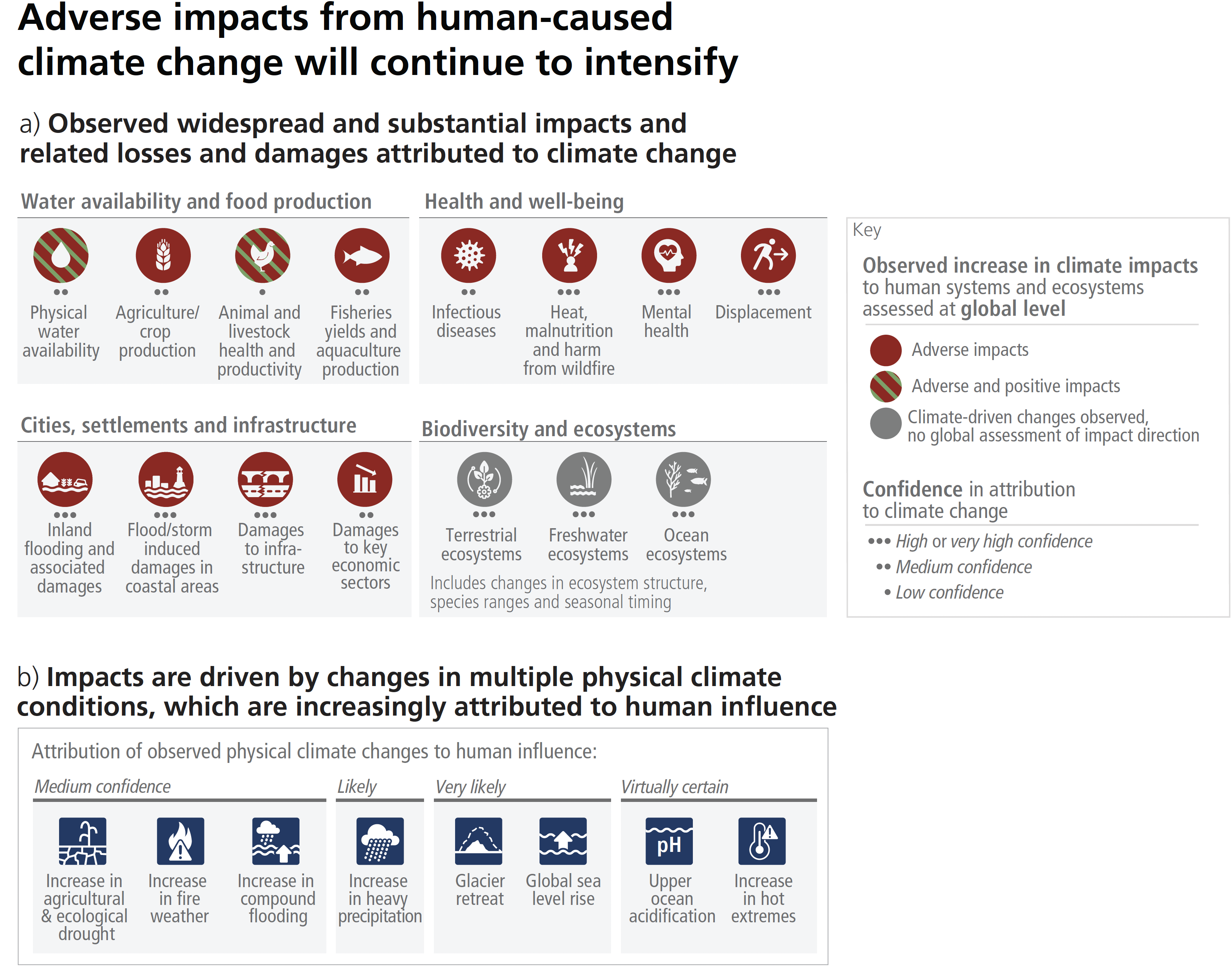

A mixed bag of bad and good

We find
a mix mixed bag of good and bad impacts;
there are aspects we are not sure, and we and not sure.
What activists don’t tell

What deniers don’t admit

Tales from either camps

Scientists don’t talk like that

The two camps

The truth: somewhere in between

Doomsday talks

Independent Thinking
So, we shouldn’t sing-along, with neither the deniers nor the alarmists.
We are called to a camp that is neither. We are called to the 3rd camp. Not because we don’t dare to speak. Not because we don’t care. But because that’s where the truth lies. And that’s how we care for Creation.
The 3rd camp

Zooming out
The Roman Catholic Church | |
|---|---|
Green efforts began decades ago, long before the rise of green movements. | There’s some catching up to do. |
Operating from community levels, it pioneered recycling programs around the world, long before cities got interested. | Much of Pope Francis’ Laudato Si’ has been in advocacy (and finger-pointing). |
Since decades ago most Tzu Chi buildings around the world have a consistent built: sustainable and energy-efficient, with purpose-built, in-house gray-water systems. | Some consistency would help. Some parishes lag behind city efforts e.g. composting. Most parishes over-bake in the winter (we need to remove our jackets) and super-chill in the summer (we need sweaters). The Church is a massive fossil-fuel-burning powerhouse everyday. Liturgical calendar and vestments remain oblivious and insensitive:
|
Dos and don’ts
DON’T | DO |
|---|---|
don’t be motivated by “disasters” | be motivated as part of creation |
starting point: “climate change” | starting point: creation |
talk doomsday condemn others shout and curse louder counter falsehood with falsehood pretend to know more | stop doing what we shouldn’t start doing what we should |
We are part of creation
We are not superior to fellow creatures.
Reverend Moon 🌙
The moon by nature plays an intercessory role. A piece of rock by its own, it emits no light. Since it emits no light, weren’t we not supposed to be able to see the moon?
Of course we do see the moon! That’s because it reflects rather than emits light. That’s why I say: the moon’s role is always intercessory. It reflects the light from the sun.
We can’t look directly at the sun without damaging our eyes. That is why we need eclipse glasses. But it is totally safe to look directly at the moon without hurting our eyes. The moon is meant for us to look at. The moon is there for us to look at.
I discovered back in 2025 that my plants need not just sun light, but moon light as well. They need not just photo-synthesis, but lunar-synthesis.
A year later I figured that like the plants, me too, I need moon light, and my body lunar-synthesizes. So I started moon-bathing. Whenever the moon visits, I turn off the lights, drop all occupation, and moon-bathe.
My horse teacher used to say horses have a different mood every day, just like us, and that is due to various factors. One of the factors is the moon.
The Tang Dynasty boasts a burst of some of the most flamboyant poems in history. Among those ancient poems, the moon is mentioned far many times more than the stars and the sun.
The stars are a mystery; we are curious about them. The moon plays quite a different role: it understands our deepest being.
As the sun courts the moon, and the two dance in the sky, may we as bystanders share that outpouring shower of grace.
The moon looking at us on June 10th, 2025.
Reverend Horse 🐎
Once whilst on a train in England I was looking out of the window. The grazing horse in the field that came into my view presented such beauty that I felt too shy even to continue looking.
Men are creatures as much as horses are. Janet L. Jones’ Horse Brain, Human Brain: The Neuroscience of Horsemanship is for me the ultimate book most powerful for spiritual growth.
It is all in the way we relate with fellow creatures. It takes the tragic death of a young tourist on a horse-drawn carriage for folks to finally stop and finally think.
How would Francis of Assisi say?
Immediately following the accident, news from Central Park reports,
The horse will be retired from the business.
Reverend Horse!
If a runaway horse ought to be retired, we would have no horse left to ride or to relate with. Almost every horse runs away that every now and then, when triggered. Most of the time we can’t make out what was the trigger. Horses are flight animals.
Will the same family go on horse-drawn carriages again? Probably not.
Shaken by the news, will other tourists dare going on horse-drawn carriages again? Probably not.
Horsemen get thrown off horses all the time. Do they ride again? Of course. Too many do.
Injuries are sometimes less serious compared to other times e.g. Superman Christopher Reeve’s.
Horsemen witness fellow riders fall, some very severely injured. Do they continue riding? Of course. Too many do.
The key lies in the human-horse relation. Horsemen on horsebacks versus tourists on horse-drawn carriages: the human-horse relation is totally different. That’s why horsemen return to horsebacks after being thrown off.
It is just better to relate with reverence and appreciation.
- Calvin, K., Dasgupta, D., Krinner, G., Mukherji, A., Thorne, P. W., Trisos, C., Romero, J., Aldunce, P., Barrett, K., Blanco, G., Cheung, W. W. L., Connors, S., Denton, F., Diongue-Niang, A., Dodman, D., Garschagen, M., Geden, O., Hayward, B., Jones, C., … Ha, M. (2023). IPCC, 2023: Climate Change 2023: Synthesis Report. Contribution of Working Groups I, II and III to the Sixth Assessment Report of the Intergovernmental Panel on Climate Change [Core Writing Team, H. Lee and J. Romero (eds.)]. IPCC, Geneva, Switzerland. (P. Arias, M. Bustamante, I. Elgizouli, G. Flato, M. Howden, C. Méndez-Vallejo, J. J. Pereira, R. Pichs-Madruga, S. K. Rose, Y. Saheb, R. Sánchez Rodríguez, D. Ürge-Vorsatz, C. Xiao, N. Yassaa, J. Romero, J. Kim, E. F. Haites, Y. Jung, R. Stavins, … C. Péan, Eds.). Intergovernmental Panel on Climate Change (IPCC). 10.59327/ipcc/ar6-9789291691647
- Calvin, K., Dasgupta, D., Krinner, G., Mukherji, A., Thorne, P. W., Trisos, C., Romero, J., Aldunce, P., Barrett, K., Blanco, G., Cheung, W. W. L., Connors, S., Denton, F., Diongue-Niang, A., Dodman, D., Garschagen, M., Geden, O., Hayward, B., Jones, C., … Ha, M. (2023). IPCC, 2023: Climate Change 2023: Synthesis Report. Contribution of Working Groups I, II and III to the Sixth Assessment Report of the Intergovernmental Panel on Climate Change [Core Writing Team, H. Lee and J. Romero (eds.)]. IPCC, Geneva, Switzerland. (P. Arias, M. Bustamante, I. Elgizouli, G. Flato, M. Howden, C. Méndez-Vallejo, J. J. Pereira, R. Pichs-Madruga, S. K. Rose, Y. Saheb, R. Sánchez Rodríguez, D. Ürge-Vorsatz, C. Xiao, N. Yassaa, J. Romero, J. Kim, E. F. Haites, Y. Jung, R. Stavins, … C. Péan, Eds.). Intergovernmental Panel on Climate Change (IPCC). 10.59327/ipcc/ar6-9789291691647